
Yorkville Previous Resident Sources
No single roll names every person tied to a Yorkville address. The county parcel map supplies the current PIN, or parcel identification number, plus lot and municipality clues. The Recorder preserves instruments that transfer or affect title. Historical directories, maps, newspapers, and census material can then place people or uses at a date. The table separates these roles so an owner name is not mistaken for a full household.
| Yorkville source | Dated reach | Repository | Best evidence |
|---|---|---|---|
| Recorder deeds and plats | Land records begin in 1841; online cutoff not confirmed | Kendall County Recorder counter and Laredo | Grantor, grantee, instrument, legal description, subdivision and lot |
| Biographical directory | 1876 | University of Illinois digital book | Selected names, family facts, occupation, property and years in county |
| Business and farm directories | 1870 and 1917 | KendallKin and GenealogyVillage | Dated business, proprietor, farm, route and telephone leads |
| Sanborn map | November 1892 | Library of Congress and UIUC | Building footprint, use, block and house numbers |
| Atlases and newspapers | Selected atlases 1903-2014; newspaper microfilm from 1864 | Yorkville Public Library and digital archives | Landowner, patron, road, notice, obituary and business context |
| Census and county series | Federal and state schedules; local series vary | Library, State Library and IRAD | Households and historical county records subject to release rules |
For a recent transfer, start with GIS and the recorded deed. For a nineteenth-century question, a legal description, township, atlas, and directory entry may be more useful than the current house number. The Yorkville Public Library local-history room is the strongest fallback when a record is not searchable online. Staff can help identify microfilm, atlases, archived material, and the right repository, while the library reference form accepts a surname, building, newspaper, or cemetery question.
Map Yorkville Address Changes
A present address is a starting point, not a promise that the same label appears in older records. The Kendall County GIS Portal connects an address or PIN to parcels, subdivisions, cadastral layers, and historic imagery. Its published sequence ranges from an 1830 survey through nineteenth-century plats, a 1939 aerial, 1940 zoning, and aerial views through 2024. The county warns that document history before 2020 and time-slider dates before 2019 are incomplete. Treat a date or blank field as a lead, not final proof.
Yorkville adds two local complications. Bristol and Yorkville consolidated in 1957, and Route 47 bridge and realignment work changed downtown circulation in the 1960s. A source may also use a township label even when the current municipality is Yorkville. No official citywide renumbering table was found, so compare the legal description, parcel history, historic street map, newspaper directions, and mapped building instead of guessing that two similar addresses are identical.
One county parcel note may say NEW PARCEL and cite a document number. That number points toward a deed or plat, but does not establish the full ownership chain. Copy it into Recorder research and inspect the actual instrument.
Trace Yorkville Past Residents Backward
Ownership is the most stable spine for an address timeline. The Kendall County Recorder records deeds, mortgages, liens, releases, and plats at 502 S. Main Street. Its research area is open weekdays from 8:00 a.m. to 4:00 p.m.; plat research stops at 3:00 p.m. Staff do not perform broad searches or give legal advice. Bring a PIN, legal description, likely names, document number, subdivision or lot, and a narrow date range.
- Enter the site address or PIN in the county GIS Quick Lookup. Record the legal description, municipality, township, parcel notes, and any created or retired document number.
- Find the newest purchase deed through the Recorder counter or subscription-based Laredo party and tract index. Read the instrument itself rather than relying on the index line.
- Take the seller on that deed and search that person as a grantee, the party who received title, in an earlier transfer. Match the legal description and lot.
- Repeat the link backward. Note mortgages, releases, plats, parcel splits, and name variations without treating them all as changes of occupancy.
- When remote coverage ends or a result is uncertain, use deed books, microfilm, IRAD, library atlases, and counter help. State clearly when the inspected index did not reveal a record.
- Grantor and grantee
- The grantor transfers an interest. The grantee receives it.
- Chain of title
- The linked sequence of recorded transfers affecting the same land.
- Legal description
- The formal land description in an instrument. It can remain useful when a street name or number changes.
- Parcel
- A mapped unit of land identified by a PIN. A parcel can split, merge, or retire.
Yorkville Previous Residents in Archives
The Yorkville Public Library local-history collection joins sources that rarely meet in one search box. It holds local books, atlas years, newspaper microfilm, obituary indexes, cemetery material, historical census supplements, and onsite genealogy databases. Archived items require staff help, and some tools are available only in the building. Its Kendall County Record microfilm begins in 1864, while the obituary project covers ten-year files from 1951 through 2020. Coverage after 2020 was not confirmed.
The library's official collection page shows how the room and archive are accessed:
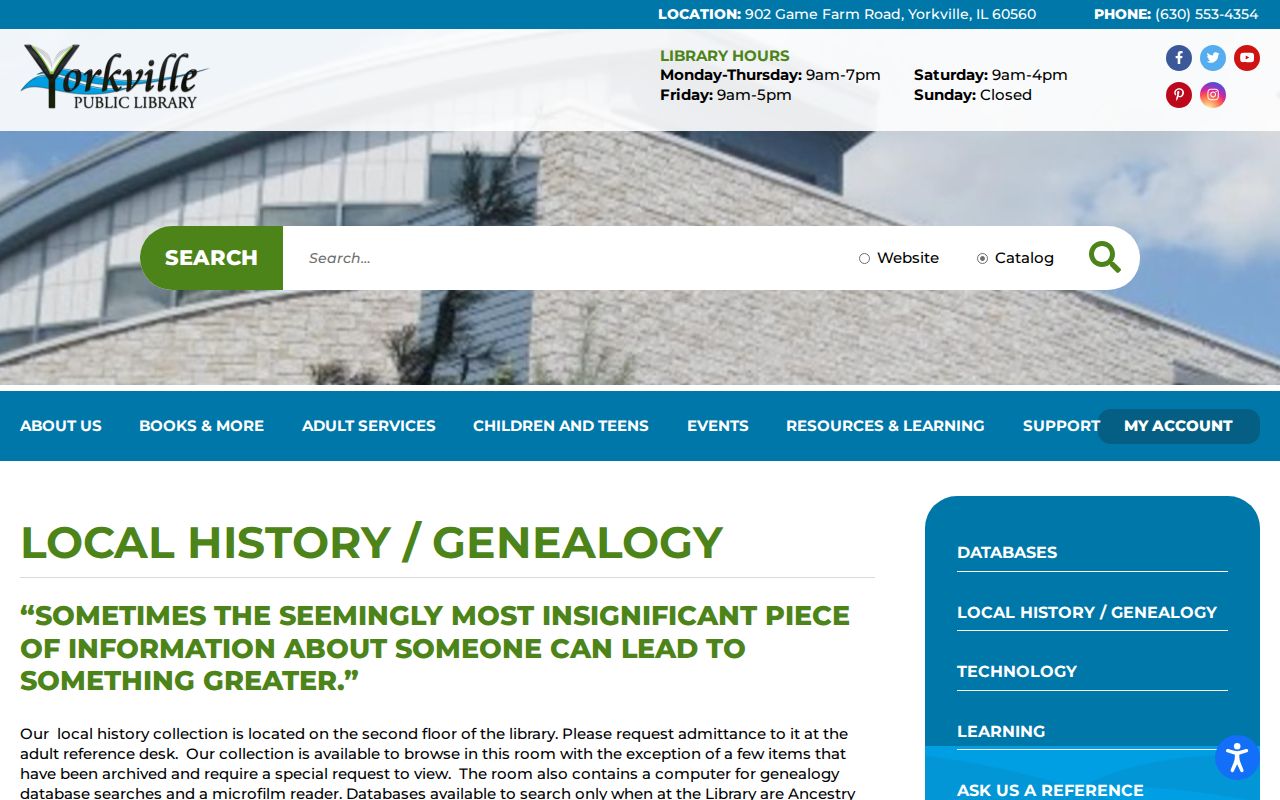
This route matters when an address search stalls. A librarian can help turn a street, surname, building, or cemetery question into a dated newspaper, atlas, obituary, or book search.
For remote help, the library provides an Ask Us a Reference Question form. It asks for the inquiry, sources already tried, contact choice, and best time:
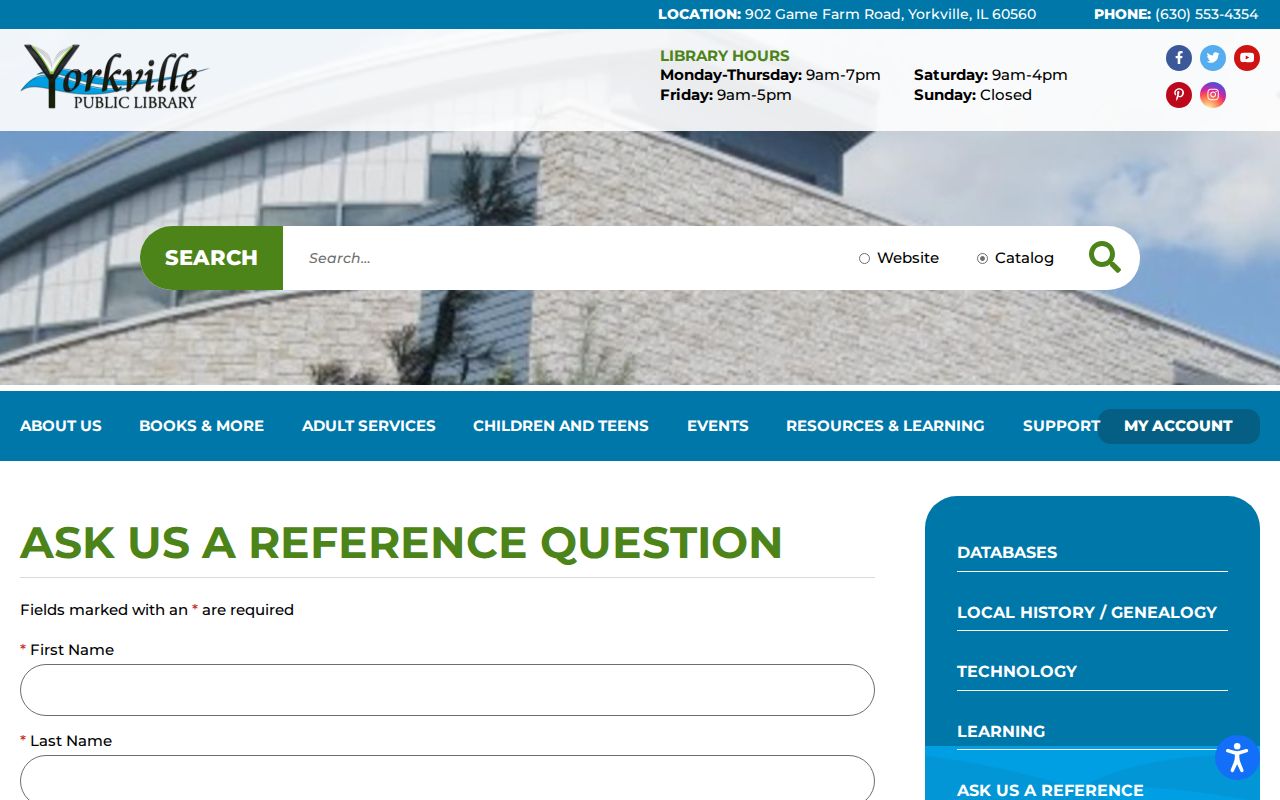
A focused request works best: give the old and current address, the likely decade, known names, and the records already checked. Do not send sensitive family details that are not needed for the search.
Read Yorkville Historical Snapshots
The 1870 Yorkville Business Directory treats Bristol and Yorkville as a combined business point and groups named businesses by trade. The surviving page records the commercial world of stores, blacksmiths, wagon makers, mills, tailors, and other services:
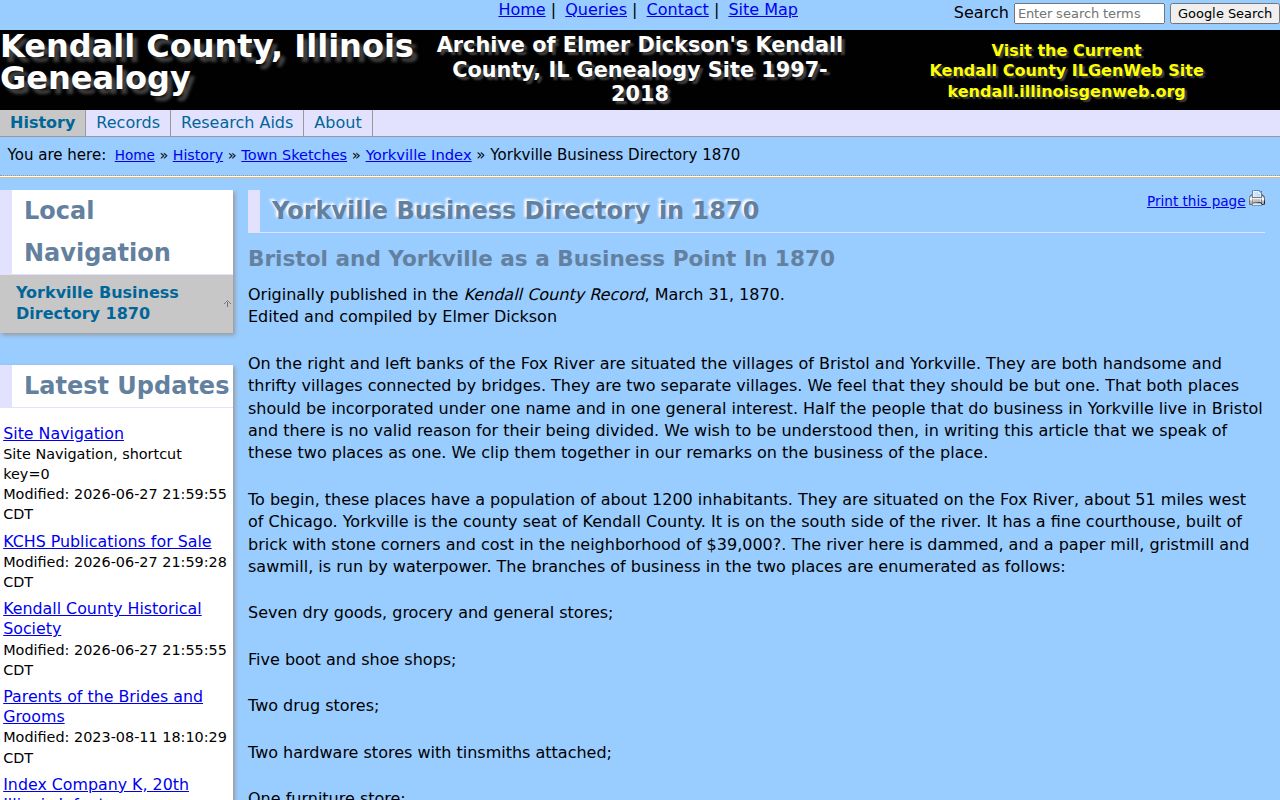
The entry is evidence of a named business or proprietor at a date, not proof that the person slept at the shop or remained there for years. Pair it with a deed, newspaper, census, or map.
The 1876 Biographical Directory of the Voters and Tax-Payers of Kendall County adds selected family, birthplace, occupation, property, and county-residence details. The 1892 Sanborn map shows structures, uses, street and block numbers. Atlas runs at the library add dated road and landowner context. Each snapshot has a scope. None proves uninterrupted residence between editions.
A useful Yorkville quirk is the reported 1914 telephone book that covered several nearby towns, not Yorkville alone. Its surviving volume or scan has not been confirmed. Search regional catalog terms before concluding that no telephone entry exists.
Pair Yorkville Residents by Date
A dated directory becomes more useful when it is paired with a source from the same era. The 1876 Kendall biographical volume can supply a selected resident's occupation, birthplace, family facts, property description, and years in the county. Those fields can guide a census, deed, newspaper, church, or cemetery search, but the book covers voters and taxpayers rather than every person in Yorkville. Cite the page and describe its limited scope.
Move forward or backward to the nearest available source. The 1917 Prairie Farmer directory uses rural fields such as acreage, landholder or occupier status, section, route, farm name, residence year, and telephone. A federal or Illinois census can then test the household connection, while a newspaper may explain a move, death, sale, or business change between snapshots. Keep every conclusion tied to its publication date. A gap in an edition is not proof that a person left.
Route Early Yorkville Resident Records
Repository history matters for the earliest previous residents. Kendall County was organized in 1841. Yorkville held the county seat through 1845, Oswego held it from 1845 through 1864, and records returned to Yorkville in June 1864. An early clerk, court, land, or tax reference may therefore use Oswego even when the property is now researched through a Yorkville office.
Start with the current custodian, then use the Illinois Regional Archives Depository Kendall inventory for transferred series. IRAD's Kendall material is served through Northern Illinois University, while Yorkville Public Library and the Illinois State Library add census and local-history routes. Ask for a named record series and date span. “Kendall County records” is too broad to reveal whether a volume stayed with the Recorder, moved to an archive, or survives only through microfilm.
Confirm Yorkville Past Households
A deed names parties to a land transaction, not all previous residents. Move from the title chain to the household layer. Search the nearest dated directory or atlas for a name or address, compare it with a released census schedule, then check the Kendall County Record, obituary index, cemetery material, probate series, and church records. A newspaper notice can connect a person to a building or event, but the original issue should confirm the index entry. The full runs and publishers belong on the Yorkville city directory page.
The clean process is: address and PIN, then deed party, then dated directory or map, then census or newspaper corroboration. Record what each source actually says. “Named as grantee in a 1903 deed” is sound. “Lived there in 1903” needs separate occupancy evidence. When past residents disappear between years, consider death, a move, a parcel change, a new street label, or simply a gap in the surviving collection.
Early county research may also shift repositories. Yorkville served as county seat from 1841 to 1845, Oswego from 1845 to 1864, and Yorkville again after records returned in 1864. The IRAD Kendall County page helps locate transferred series at Northern Illinois University. Search by record series and era, not only by today's repository name.
Lawful use. Research past residents for genealogy, estate work, house history, or personal curiosity. Never use an address trail to track, intimidate, or harm a living person.